Wednesday, 14 November 2012

A Classic's Challenge: November Prompt


We're ready for the month's prompt from November's Autumn. Here we go.

One of the books I
immensely enjoyed.
Of all the Classics you've read this year is there an author or movement that has become your new favorite?
New favourite? Well, I have always loved Dumas, so I guess it's not a “new” favourite, but I've been enjoying more books from him, namely The Three Musketeers and Twenty Years After. I'd like to say also that I like Victor Hugo's Les Miserables, long as it is.

Which book did you enjoy the most?
I immensely enjoyed Three Musketeers and Twenty Years After. I also enjoyed Ivanhoe, but not as much as the former two.

Or were baffled by?
I'm a little baffled by Ivan Denisovich. It's my first time reading Russian literature, and even now I haven't written its review. I don't know where to start. I mean, it's truly only a day of Ivan's life, but the book has very intense air and so long for a diary.

The best character of my choice, Athos
Who's the best character?
I don't need to think twice – Athos, aka Comte de la Ferre. He is a wonderful character – with flaws. Just perfect, for me. If I could marry a fictional character, I would marry him. (In two months time, my favourite will change, trust me.)

The most exasperating?
Thernadier in Les Miserables. He's more than annoying – he's unbearable!

From reading other participants' posts which book do you plan to read and are most intrigued by?
Margaret's post mentions Tale of Two Cities by Dickens. I think I'm going to read it next year. This year's reading is too much already.

Tuesday, 13 November 2012

Les Miserables, Vol IV: Different Shades of Love


The fourth volume of Les Miserables is about love. It talks much about love and little about anything else. My reading was not as joyful as the other volumes, perhaps because I read it with less concentration and speed than the previous volumes.

This volume feels a lot longer than the others I have read. Fifteen books! There are so many things worth noting, too many things that it's so difficult to determine what I should be talking about before anything else.

So I will talk just about love.

The first love is paternal love so intense and so deep that it becomes possessive and selfish. Jean's love for Cosette is undoubted. He refuses all luxury for himself but denies Cosette nothing. Cosette is his pearl and treasure. He is also very protective but kind to her. It's a pure fatherly love, like the love from God to His children – but a little bit too much. Jean, tasting love for the first time, begins to fear the possibility of not being loved any longer, as if love is divisible, as if love is a finite thing which amount will decrease when ir is given to more people. Also, because he well knows that he is Cosette's nobody, his fear becomes even bigger.

“ I have been first, the most wretched of men, and then the most unhappy, and I have traversed sixty years of life on my knees, I have suffered everything that man can suffer, I have grown old without having been young, I have lived without a family, without relatives, without friends, without life, without children, I have left my blood on every stone, on every bramble, on every mile-post, along every wall, I have been gentle, though others have been hard to me, and kind, although others have been malicious, I have become an honest man once more, in spite of everything, I have repented of the evil that I have done and have forgiven the evil that has been done to me, and at the moment when I receive my recompense, at the moment when it is all over, at the moment when I am just touching the goal, at the moment when I have what I desire, it is well, it is good, I have paid, I have earned it, all this is to take flight, all this will vanish, and I shall lose Cosette, and I shall lose my life, my joy, my soul, because it has pleased a great booby to come and lounge at the Luxembourg.”

This love materialises into series of inquiries, series of suspicion, and ends in hatred towards the rival: Marius. Happily, though, such hatred doesn't go further, because Jean thinks that Marius is going to die anyway, and his rivalry will end. It won't be so, will it?

Marius' love is another shade of affection. It's a gentle and warm love. It's amorous, but neither fierce nor ardent. The love in him is so deep that it overcomes lust, because lust is a lesser form of love.

“They touched each other, they gazed at each other, they clasped each other’s hands, they pressed close to each other; but there was a distance which they did not pass. Not that they respected it; they did not know of its existence. Marius was conscious of a barrier, Cosette’s innocence; and Cosette of a support, Marius’ loyalty. The first kiss had also been the last. Marius, since that time, had not gone further than to touch Cosette’s hand, or her kerchief, or a lock of her hair, with his lips. For him, Cosette was a perfume and not a woman. He inhaled her. She refused nothing, and he asked nothing. Cosette was happy, and Marius was satisfied.”

What I object, though, from Marius' love, is lack of determination in his part. Marius easily gives up to obstacles. As we can conclude form the last volume, Marius is a proud young man, and the same pride costs him his grandfather's blessing for his marriage. If he could just stay and say why he loves this lady so, his grandfather who loves him so much would surrender to his will. Also to choose death as an escape from his problems is not a very commendable thing to do. Marius is such a gentle person, and I like that, but he's not yet mature enough to be called a man.

The other shade is Eponine. She loves Marius dearly, and at least the does something to get him from Cosette. She fights for her love for Marius in a better determination than Marius, fighting for Cosette's. Eponine dies sacrificing herself for Marius' life, thus declaring herself as a better lover of the two. Marius loves as a scholar does, Eponine, as a knight.

“Promise to give me a kiss on my brow when I am dead.—I shall feel it... And by the way, Monsieur Marius, I believe that I was a little bit in love with you.”

The 4th volume of Les Miserables is a volume of love. There are too many love to write completely here. There is love for the country, for the people, that materialises in civil war; Enjolras and his friends are agents of it. There is love of a boy to other children whom he hardly know, and yet love doesn't withhold its kindness. That boy is Gavroche.

I still hope that somehow the end will be happy. Let every man gets what he deserves, not by the law of men, but by the greater law, the law of love.


Friday, 9 November 2012

Weekend Quote #18


CASSIUS. You love me not.
BRUTUS. I do not like your faults.
CASSIUS. A friendly eye could never see such faults.
BRUTUS. A flatterer's would not, though they do appear
As huge as high Olympus.

Following the LRP, I take a quote from Shakespeare's Caesar that attracts my attention. It's from the 4th Act and 3rd scene of Julius Caesar. In that scene, there arises a dispute between Brutus and Cassius, and a very fierce one.

Brutus accuses Cassius of dishonesty and corruption, while Cassius denies everything. He says that in a time like that, “it is not meet that every nice offense should bear his comment” - you cannot be too strict on little things like that. Brutus is too idealistic and less practical; he cannot accept such excuses.

Cassius then says that a friend should not be so angry upon such a small matter, and that Brutus should have overlooked it. I like how Brutus answers. Friends should see faults, flatterers do not.

I agree with that. It is a friend's duty to look at faults and warn someone of its consequence. It's better to hear a critic from a friend than a praise from an enemy – you now which one you should believe. A friend that is so passive and just stay still while seeing his friend making wrong decision is not a true friend.

That's all from me, and I'm waiting for your participation. What's the best quote you've got this week?
-----------------------------------------------------------------


Weekend Quote is hosted by Half-Filled Attic. Feel free to join. You can:

  • Give the context of the quote
  • Give your opinion whether you agree or disagree with it
  • Share your experience related to the quote
  • Share similar quotes you remember
  • Or anything else. Just have fun with the quote.

Thursday, 8 November 2012

Bad Translation: Julius Caesar


Just a break. Here's Act 1 Scene 2 of Julius Caesar for those who need relief from the complex language of Shakespeare.

CASCA. Narik-narik jubahku mau ngomong apa?
BRUTUS. Tadi ada apaan? Kok mukanya Caesar ga enak?
CASCA. Lho, bukannya kamu tadi sama dia?
BRUTUS. Ya kalo tadi aku di situ ga usah nanya kamu dong.
CASCA. Tadi dia ditawarin jadi raja, terus dia nolak, terus orang-orang heboh deh.
BRUTUS. Terus yang ribut-ribut kedua apaan?
CASCA. Itu juga.
CASSIUS. Yang ketiga?
CASCA. Itu juga.
BRUTUS. Mereka nawarin mahkota tiga kali?
CASCA. Iya. Dan dia nolak tiga kali, makin lama makin ga niat nolaknya. Tiap kali dia nolak, sesamaku rakyat jelata itu pada bersorak.
CASSIUS. Yang ngasih dia mahkota siapa?
CASCA. Antony.
BRUTUS. Cerita dong.
CASCA. Ga jelas lah, konyol banget pokoknya. Jadi Antony nawarin dia mahkota, terus dia taruh lagi, Tapi kata aku sih sebenernya dia pingin banget ngambil. Terus ditawarin lagi, terus dia taruh lagi. Tapi kata aku sih, dia kayanya benciiii banget ngelepasin itu mahkota. Terus untuk ketiga kalinya dia ditawarin lagi, dia taruh lagi, dan orang-orang langsung heboh, tepuk tangan, dan ngelemparin topi mereka ke udara. Saking udah ga jelasnya bau keringet dan bau mulut mereka Caesar sampai tersedak, trus pingsan deh. Aku sih nahan ketawa supaya ga ngehirup baunya.
CASSIUS. Caesar sakit apa?
CASCA. Dia jatuh, mulutnya berbusa.
BRUTUS. Epilepsi-nya kumat.
CASSIUS. Nggak. Yang epilepsi itu aku, kamu, sama Casca di sini.
CASCA. Aku nggak ngerti kamu ngomong apa, pokoknya Caesar pingsan.
….
BRUTUS. Terus waktu udah sadar dia ngomong apa??
CASCA. Ya sebelum dia pingsan, waktu dia nyadar bahwa orang-orang itu seneng dia nolak jadi raja, dia buka jubahnya terus ngasih tenggorokannya buat dipenggal. Kalo aku rakyat jelata yang ga punya kerjaan sih pasti udah aku lakuin. Terus dia pingsan. Waktu udah sadar, dia bilang kalo tadi ada khilaf, itu gara-gara penyakitnya. Tiga atau empat perempuan di situ bilang, “Ya ampun, kasian banget ya,” dan maafin dia setulus hati. Peduli amat lah, mereka. Kalaupun Caesar abis nikam ibu mereka juga kayanya dia dimaafin aja.
BRUTUS. Trus abis itu mukanya jadi serius gitu??
CASCA. Hooh.
CASSIUS. Tadi Cicero ngomong sesuatu?
CASCA. Ya. Dia ngomong pake bahasa alien.
CASSIUS. Ngomongin apa?
CASCA. Ga tau. Tapi yang ngerti dia ngomong apa senyum-senyum, terus geleng-geleng, tapi buat aku sih rasanya kaya dengerin bahasa alien.
….
BRUTUS. Perasaan dulu di sekolah dia rada pinteran dikit.

And here's Act 2 Scene 2 condensed.

CALPHURNIA. Caesar, aku udah tiga kali mimpi kamu dibunuh, Jangan berangkat.
CAESAR. Gue ga takut. Namanya juga orang ya pasti bakal mati kalo udah waktunya.
SERVANT. Kata para imam juga mendingan Caesar ga usah keluar rumah hari ini.
CAESAR. Bah. Takdir aja takut sama gue. Gue berangkat.
CALPHURNIA. Ya ampun! Udah jangan kepedean gitu. Jangan pergi. Bilang aja aku yang takut terjadi apa-apa, bukan kamu. Suruh Antony bilang kamu ga enak badan.
CAESAR. Ya udah, suruh Antony bilang aku ga enak badan, biar kamu tenang.
DECIUS. (manas-manasin)Masa sih Caesar ga datang gara-gara istrinya mimpi buruk. Nanti Senat bilang apa? “Rapat ditunda sampai istrinya Caesar mimpi indah, gitu?” Belum lagi ntar anggota-anggota Senat bisik-bisik, “Caesar takut ya?”
CAESAR. (kesel sendiri)Siniin jubah gue. Gue berangkat.

Wednesday, 7 November 2012

Character Thursday: Portia in Shakespeare's Julius Caesar


Have I ever taken anyone from Shakespeare to be my Character Thursday? I can't remember. But the lady whose name is written clearly up there certainly deserves a place in this, or any other, blog. Portia – Cato's daughter and Brutus' beloved wife.

Portia's part is quite minor in the play. She appears after the conspirators' meeting in Brutus' house. She is anxious about the well-fare of her husband, and insists upon knowing the secret that Brutus keeps, promising that she won't leak it out.

What's interesting about Portia is the words she uses to convey her feelings to Brutus. As his wife, she demands Brutus to think of her as half himself, that she should partake in everything Brutus must face.

Within the Bond of Marriage, tell me Brutus,
Is it excepted, I should know no Secrets
That appertaine to you? Am I your Selfe,
But as it were in sort, or limitation?
To keepe with you at Meales, comfort your Bed,
And talke to you sometimes? Dwell I but in the Suburbs
Of your good pleasure? If it be no more,
Portia is Brutus Harlot, not his Wife

In Portia's mind, marriage is more than just living together, having meals together, and have fun together. It includes being “one flesh”, not “in limitation” but in all things. Being married to someone means that you are ready to share everything – good or bad – with your spouse. And to listen to such a thing from a woman, moreover, in Shakespeare's era, is something quite modern.

Another point worth noted from Portia is her opinion about herself. She admits that although there are many “weak women”, Portia is certainly not one of them.

I graunt I am a Woman; but withall,
A Woman that Lord Brutus tooke to Wife:
I graunt I am a Woman; but withall,
A Woman well reputed: Cato's Daughter.
Thinke you, I am no stronger then my Sex
Being so Father'd, and so Husbanded?

She says that being a daughter of Cato and the wife of Brutus, she must be a strong woman worthy of her father and husband. By saying she's “stronger than her sex,” she underlines that she can handle things other women cannot. She proves it first by deliberately wounds herself and later, by swallowing fire – committing suicide.

Brutus admits that her death is a great lost in his part, and yes, such a woman deserves not only love but also respect from her husband. She may be a minor character in this play, but not weaker in characterisation.  

Tuesday, 6 November 2012

Julius Caesar: Melancholic Political Intrigue


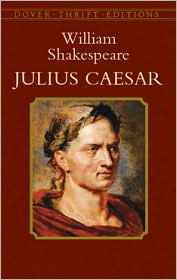
The first Shakespeare's play that I choose to read is Julius Caesar. It's actually a re-read, since I have always loved it and since I have read it times before, paying more attention to the scenes that I love such as Antony's speech and Brutus' quarrel with Cassius.

Julius Caesar is one of the most well-known Shakespearean play. It is so interesting because it brings the audience of the play into fantastic thrill and anticipation of Caesar's murder.

When will Caesar Die?

Early in the play, that is Act 1 Scene 2, a soothsayer says to Caesar, “Beware the ides of march.” It's a prophecy that must come true in the play. Besides, everybody knows that he's going to die anyway. But one thing is still unclear – when.

Then Cassius appears, persuades Brutus to join the conspirators. He says yes, but not yet feels resolved about it. After thinking it through, and not without some doubt, Brutus makes his decision. The conspirators then meet in Brutus' house and plan to kill Caesar the next day at the Capitol. But the drama isn't over yet.

At Caesar's house, Calpurnia insists that Caesar should not go to the Capitol. The priests confirm her anxiety by saying that when they try to look for a sign, they cannot “find a heart within the beast”. At this point, I must confess, I always mutter, “Please Caesar, don't go.” Ceasar goes to the Capitol all the same, being provoked by one of the conspirators, Decius.

Even at this point, Shakespeare hasn't given up in his attempt to preserve Caesar's life. Artemidorus tries to warn Caesar, but fails. That's why we call the play a tragedy.

Rome without His Hart (or Heart)

The best part of the play, however, comes after Caesar's death. Mark Antony's meeting with the conspirators is one of the most interesting scenes in the play. I can safely say that he's trying to trick Brutus and his friends, but he is so touched by the death of Caesar that he sometimes talks off the topic.

“That I did love thee, Caesar, O, 'tis true!
If then thy spirit look upon us now,
Shall it not grieve thee dearer than thy death
To see thy Antony making his peace,
Shaking the bloody fingers of thy foes,
Most noble! In the presence of thy corse?

O world, thou wast the forest to this hart,
And this, indeed, O world, the heart of thee.”

As if those lines weren't enough to express his feelings, he speaks some more after he is left alone with Caesar's corpse.

“O, pardon me, thou bleeding piece of earth,
That I am meek and gentle with these butchers!”

Antony then proves his words by giving a speech in Caesar's funeral, inflames people's hearts to drive the conspirators out of Rome. He also speedily fetch Octavius and talks upon political matters with him (and Lepidus). Antony, who has been very quiet before Caesar's death, suddenly proves himself to be a man of action.

Another interesting scene is Brutus' quarrel with Cassius. Brutus is more a scholar than a politician, at least from Cassius' point of view. He has his idealism, and lives up to it. That's something to be proud of, but it's not practical in that situation. Brutus accuses Cassius of corruption, and Cassius is enraged.

One thing to note, though, that during their conversation, Brutus again states his reason for killing Caesar.

“Remember March, the ides of March remember.
Did not great Julius bleed for justice' sake?
What villain touch'd his body, that did stab,
And not for justice?”

Meanwhile, we can see the signs of disagreement between Antony and Octavius.

“ANTONY. Octavius, lead your battle softly on,
Upon the left hand of the even field.
OCTAVIUS. Upon the right hand I, keep thou the left.
ANTONY. Why do you cross me in this exigent?
OCTAVIUS. I do not cross you, but I will do so.”

Aha! They don't fit each other after all. I must say I like better Cassius – Brutus' partnership than Antony – Octavius'. No offense, Octavius, but I like Julius and Antony better.

Overall, Julius Caesar is one of the best plays written by Shakespeare. For em personally, the language is not as hard as other plays (e.g: Romeo and Juliet and also Hamlet) and it's pretty fun to read. The lines are dramatic, the story is excellent, and there are so many things to talk about when you read the play.

I have written too much now. So, for those who join the Let's Read Play event, have fun with your reading, and share your experience with us. 

Sunday, 4 November 2012

Classic Club November Meme: Intimidating Books


Huft. Intimidating books? Let's be honest. I classify intimidating into 2 categories: intimidating story and intimidating length. Let's look at each of them.

Intimidating Length:

Les Miserables
I really had no idea about its length when I first put it on my list. I mean, I thought it wouldn't be as scary as Monte Cristo. I was wrong. Taking up the book from my pile of to-read novels is really something. I finally took it for a read-along. I won't be able to read it otherwise. Fortunately, the book captivates my heart right at the first volume. Tedious as it is in certain parts, I find the book to be inspirational and touching. I'm reading the 4th volume now, and I hope to finish it on December.

Candide
It's a long book indeed. Another fact: I have never read Voltaire before. The story also seems to be complicated. I think I will wait for another read-along before I pick that up.

Intimidating story:

Man in the Iron Mask
I hate sad endings. Those who know me well know too well of that fact. Accidentally (or not), I read the synopsis of it once. It frightens me to read such an ending for the four heroes I truly adore. I just can't. But I know I have to read it sooner or later.

Othello
Same thing applies. Othello, the one that loves “not wisely but too well” is very lovable. I watched the opera by Verdi and fell in love with him at the first sight. He has the manliness of a soldier and gentleness of a prince. Knowing how the story would end, I have put the story in my reading list without ever dared to touch it. That's why I pledged to read it in Classic Club's Project.

Those are the most intimidating books in my reading list. Let's hope I won't change my mind and actually read them and finish them all.