Thursday, 28 February 2013

Robinson Crusoe Read-along: Master Post


It's not easy for me, and I fee very much inadequate to hold a read-along of a certain book which I have never read before. Let me tell you in advance that I know nothing whatsoever and have never watched any adaptation of this novel. Therefore I apologise for my ignorance, should it prove disturbing for those who join this read-along for a re-read.

We are going to read the novel during March, a rather long month with five weekends. It's fortunate, because some of us have so plenty to read during March. Another reason, the Classic Spin also needs to be done on March. But nothing can stop us now, haha.

So at the end of the month, each of us is expected to make a review, short or long, of the book. But because I'm not good at making review, I'd like to put some questions here to make it easier for me. You may or may not use them in your review, or you can just answer the one(s) you like.

  1. What do you think about the character?
  2. What is your favourite part of the book?
  3. How can you relate yourself with the book?
  4. What do you think of the book itself (the words, the author, or anything)?

Those are all I can think about. But feel free to add your own question and answer. Oh, and one more thing: don't forget to put the link of your review post below.

Have a nice reading.

Tuesday, 26 February 2013

Richard III: Fiction vs. Reality


So, to be able to say something about Richard III, that is, to be able to distinguish the real Richard III with Shakespeare's interpretation of the character, I've done a little research upon the matter. I believe that Shakepeare, although so great in his command of words, was not a historian. Therefore, his historical plays should not be entirely trusted as a guideline in any historical research.

Actually, prior to reading Richard III, some years ago, I read a few chapters of a book by Glenn Pierce, entitled King's Ransom in a library sort-of, but the book was gone when I came back some time later to continue my reading. In that book, Richard is described as a more modest and kind human being rather than a wicked ambitious demon. Thus these few last days I tried to find what other people say about Richard III.

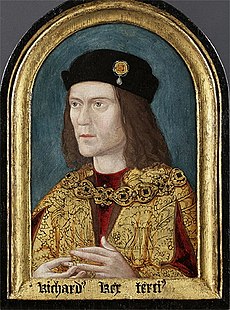
Firstly, his looks. While Shakespeare described him as a hunchback, and practically a monster in appearance, such thing is not likely the case. In Richard's time, people who went to war needed to wear heavy armours and weapons. It is very unlikely that a man with hunchback could actually go to war, on a horse, and kill his opponents dexterously. The newly found remains believed to be the king shows that Richard III was not a hunchback, although he had scoliosis. It's in harmony with Rous and More's report that one of the king's shoulder is higher than the other. [1][2]

The newly-found Richard III remains

Now, about the murders that Richard III committed in Shakespeare's story. Scholars are still debating whether Richard really committed all of those murders. It's actually interesting to read what the Richard III Society has to say about it.[3] It's not so much to conclude that Shakespeare's description of the king's homicidal character is too much dramatisation with less historical accuracy.

On the contrary, many people in Richard's era described him as a brave soldier, a good member of the family and also a good king. Instead of being a tyrant, he encouraged justice in all his region.[4][5]

Why, then, did Shakespeare write such a play, and how could such a play labelled as 'historical'?

Shakespeare complied with the general belief of his era that deformity in flesh reflects the deformity in moral qualities as well. Moreover, Shakespeare lived under the reign of a Tudor sovereign, thus it would be easier for him to glorify the present dynasty rather than to give balanced view of the former one.

Another reason. There are writings available in Shakespeare's era which might be biased and not credible. Among those are writings by Polydore Vergil and Sir Thomas More. Shakespeare was also believed to have taken his history from the Chronicles, which quality is varied when it comes to accuracy. [1]

Whether Richard to some extent had really been a bad tyrant, or whether he had been most unjustly accused of committing terrible things he had never done, most of us would agree that Shakespeare's play Richard III remains a masterpiece – even those supporting Richard wouldn't deny that. But this play reminds us all that we have to carefully choose between fact and fiction and make sure of everything before believing it entirely.

That's all I think. I am no expert in this matter, I'm sorry, but it has been fun to dig deeper into history this time. I encourage you all to read these links below, in order to see Richard III from another point of view.


Monday, 25 February 2013

Richard III: Killing, Killing and Little Else


Don't be angry with me, Shakespeare lovers. (Do we have a word for Shakespeare's fans, you know, like Sherlockians for Sherlock Holmes?) This is the first Shakespearian History that I truly read from enter to exeunt. But I cannot say that it's as entertaining as As You Like It (and I doubt it's supposed to), or as intriguing as Hamlet, or even its kin, Julius Caesar.

Richard III focuses on the events leading to Richard III's enthronement, complete with the killing of Clarence, the king, and later on, the two princes. Then the story goes to the military campaign of Richmond which later succeeded the crown.

In the play, Richard is depicted as cruel, sly, ugly, and wicked. He has been very detestable even since the start of the play. The more annoying he is, the more I don't believe the story. I mean, nobody could be that cruel. I wonder if the play could be categorized as “historical fiction” instead of “historical play.” I think I need to do further research before I determine which story I should trust and which I should distrust.

Still, the play is a good thing. Well, of course it is, Shakespeare wrote it. (Perhaps I am a little bit biased when it comes to the Bard.) My favourite scene, is perhaps, the ghosts coming to Richard and Richmond's tent, threatening and cursing the one and blessing the other. Similar scene appears in Julius Caesar, but the ghost comes to Brutus only. In this play, however, the ghosts come to both parties and make the contrast between Richard and Richmond even stronger.

That's all I think. I can't wait to do some little research and post it as a part of the #LRP event. You shall hear more Richard from me. ;)

Sunday, 24 February 2013

Bad Translation: Hamlet Act I Scene II (beberapa adegan)

(All written in Bahasa)

Sementara saya seharusnya mengerjakan sinopsis Hamlet untuk tugas kuliah psikologi (PR idaman banget ga sih?), saya malah bingung sendiri mau menulis apa, dna akhirnya membuat Bad Translation lagi.

Korban saya kali ini tentu saja Hamlet, salah satu favorit pribadi. Semua adegan di bawah diambil dari Act I Scene II. Tentu saja, saya belum sempat menerjemahkan seluruhnya. Salah satu alasannya adalah “susah” dan alasan lain “malas”. Jadi untuk sementara, silakan dinikmati.

KING
Sekarang, ponakanku Hamlet, dan anakku..
HAMLET
Saudara dekat, tapi beda jauh
KING
Kenapa wajahmu mendung banget?
HAMLET
Nggak Tuan, saya malah kesilauan.
QUEEN
Udah Hamlet jangan sedih terus gitu dong. Jangan mikirin ayahmu terus. 'Kan kamu tau semua yang hidup harus mati. Itu hal biasa.
HAMLET
Ya, Ma, itu biasa.
QUEEN
Terus kenapa kelihatannnya kamu sedih banget?
HAMLET
Kelihatannya?! Nggak, aku emang sedih banget. Nggak ada istilah 'kelihatannya'. Baju hitam, air mata, keluhan, wajah sedih, itu yang 'kelihatannya'. Orang bisa aja pura-pura, 'kelihatannya' sedih. Tapi semua yang 'kelihatan' itu bukan apa-apa, dibanding apa yang aku rasain di dalam sini.
I,ii.64-86

HAMLET
Jadi ada urusan apa kalian ke Elsinore?
HORATIO
Tuan, saya datang untuk lihat pemakaman ayahmu.
HAMLET
Jangan ngejek aku, Horatio. Aku pikir kamu dateng buat pernikahan ibuku.
HORATIO
Emang cepat sekali pernikahannya, sih, Tuan.
HAMLET
Cepet banget, banget, Horatio. Daging sisa jamuan pemakaman bisa dipake buat jamuan pernikahan.
I,ii.174-181
Mudah-mudahan mood nulis dan nerjemahinnya cepat datang supaya saya bisa melanjutkan adegan-adegan selanjutnya. And again, sorry Shakespeare.

Friday, 22 February 2013

Weekend Quote #33


“Despair and hope make thee ridiculous
The one doth flatter thee in thoughts unlikely,
In likely thoughts the other kills thee quickly”

Another quote this weekend, from dear grandpa William. I'm still in love with his Venus and Adonis, describing the goddess of love herself loving a man, a mortal man to the point of madness. She was looking for Adonis in the wood, afraid that he was dead already, when she ehard a voice of a hunter. Thinking that it might be Adonis, she uttered the words in our quote today.

As human beings, we experience despair and hope in our daily lives. We sometimes hope too high, thinking that there's hope still when it is very unlikely. At other times, we despair when the worst has not and maybe will not happen anyway. Sometimes after all is over, we look back and realise how ridiculous we are.

That's what I'd like to share with all of you this week. Have a nice weekend and don't forget to share anything if you want to.


A Modern March: A Classic Club Event


Allie from A Literary Odyssey is hosting the event in March. The idea is reading books written by the Modernist.

Some of the big writers of the Modernist period were:
    William Faulkner
    Virginia Woolf
    Ezra Pound
    F. Scott Fitzgerald
    Ernest Hemingway
    Samuel Beckett
    Gertrude Stein
    e e cummings
    T.S.Eliot
    James Joyce
There are more, of course, but those are the heavy hitters of the period and those most closely associated with the movement.

Fortunately, I have This Side of Paradise by Fitzgerald that I need to read as a part of the Classic Club Spin reading event. Therefore by signing up for this event I shall have double reason to finish the book. 

Thursday, 21 February 2013

Group Check-In #2: February 2013


Check-ins sometimes feel like a control management system of your reading progress. That's a good thing in a way, but feels like an inspection in other way. For a procrastinator like me, it's definitely a good thing to check my progress every now and then, and here it is:

I've read 16 (or 17) books from my list, most of them are parts of reading challenges. I need challenges for the same reason (apart from the thrill, of course): to get deadlines. Else I would read so slowly.

I keep changing and adding to my original list. It was first 50 books – no more, no less. But now, it increases into 55, and counting still. Reading Challenges and Reading Events make my list longer and longer, but I don't mind at all.

Right now I'm getting myself through Richard III by William Shakespeare while busying myself slowly with Adventures of Ellery Queen which seems to have a snail's progress. I also am trying my best to get through Spencer's Faerie Queene, with it's long long rhyming narrative and unusual spelling. Funny how easy it is with Shakespeare and how hard it is with Spencer.

One more thing, I get This Side of Paradise for my Classics' Spin. So, I'm reading it as well, trying to get it crossed from my list by March. I want to read Robinson Crusoe by then and I don't want to be distracted.