Saturday, 1 December 2012

LRP December Meme: Costume


“Not out of your apparel, and yet out of your suit. “ - Rosalind, As You Like It


Did you like last month's reading? Was it depressing to read so many people die? Let's relieve ourselves then. This month, we will laugh!

This month's reading theme is Shakespeare's Comedy. When we talk about plays, we will talk no doubt about stage productions, and of course, about the costumes. Costumes are important in Shakespeare's plays stage adaptations. Some try to make Shakespeare stays Shakespeare, and put vintage clothes on their casts. The others want to make Shakespeare looks modern, and change the costumes into modern ones.

This month, you may pick a play or a character, and feature the costumes you like/dislike. Here are some ideas:
  • Pick a character, and talk about his/her costumes in your favourite stage/film adaptation.
  • Pick a character, and compare costumes
  • Pick a play, and compare productions costumes
  • Pick a play, and say what you like/dislike about the costumes
  • Pick a character or a play, and say what costume you think would fit most.

Things above are just ideas. You can of course improvise. Just have fun with costumes. You can even feature yourself in somebody else's costume (Rosalind or Portia, maybe?).

The linky will open the whole month. I'm looking forward to your entries. 


Friday, 30 November 2012

Weekend Quote #21


“There are people who observe the rules of honour as one observes the stars – from a great distance.”

These are the words of Combeferre, one of the Friends of the ABC, when Feully, another member of the friendship mentions the names of people who brag that they would help the revolution, but vanish when the day comes.

I find the sarcasm in it amusing and at the same time sad. It reminds us how easy it is to talk, and how difficult it is to be true to our words. I believe that doing what we say is also part of being honourable. After all, it is better no to say anything than say a lot of things without doing it.

That is my quote this weekend. What is yours?

-----------------------------------------------------------------


Weekend Quote is hosted by Half-Filled Attic. Feel free to join. You can:

  • Give the context of the quote
  • Give your opinion whether you agree or disagree with it
  • Share your experience related to the quote
  • Share similar quotes you remember
  • Or anything else. Just have fun with the quote.


Thursday, 29 November 2012

Antony and Cleopatra: If This be Love Indeed...


Antony and Cleopatra's main theme is perhaps love. The death of Antony and his lover the queen of Egypt somehow resembles the typical love tragedy in Shakespeare and older stories, such as Romeo and Juliet, Pyramus and Thisbe, Othello, etc. But for me Antony and Cleopatra has its own uniqueness.

One of them is of course, the political theme in the play. The political theme is so intense that it blurs the theme of love at times. For example, Antony's marriage to Octavia is actually quite a shocking choice from the 'love' point of view, especially after his promise to Cleopatra. But his political motive prevails over his emotional feeling, and he chooses that path to strengthen his position in Rome. Cleopatra forgives Antony anyway.

The ups and downs of their relationship is also unique. They fight, and then they love again, and fight again, none of them loves better than the other. Their love is sometimes selfish, sometimes stupid, and it enriches the plot of the play.

I don't know if I will read the play again, given my dislike to tragedies (with few exceptions), but for me the play is entertaining enough. Here below is the list of my act-by-act review. Please enjoy.  

Wednesday, 28 November 2012

Antony and Cleopatra, Act V: The Last Empress of Egypt


The last act of the play, for me personally, is not as impressive as the others. Is that because Antony has died? Why, maybe. The queen's interaction with Octavius is somewhat awkward. Octavius is not a merciful and wise king in the old story books. On the contrary, he would do anything to make sure that he holds the supreme power over all the world.

At the beginning of the first scene, Octavius finds out that Antony is dead. He laments his death, admitting that Antony was a great man indeed.

“O Antony!
I have follow’d thee to this; but we do lance
Diseases in our bodies: I must perforce
Have shown to thee such a declining day,
Or look on thine; we could not stall together
In the whole world: but yet let me lament,
With tears as sovereign as the blood of hearts,
That thou, my brother, my competitor
In top of all design, my mate in empire,
Friend and companion in the front of war,
The arm of mine own body, and the heart
Where mine his thoughts did kindle — that our stars,
Unreconciliable, should divide
Our equalness to this.”

Meanwhile, Cleopatra has great desire for death. Yet Octavius, by means of his servants guards her life. Cleopatra desperately calls for death, but she is not allowed to die.

“Where art thou, death?
Come hither, come! come, come, and take a queen
Worthy many babes and beggars!”

One other thing that I love from this scene is Cleopatra praising Antony so, describing how she saw Antony from her point of view. She is infatuated with the Roman general.

“His face was as the heavens; and therein stuck
A sun and moon, which kept their course, and lighted
The little O, the earth.
….
His legs bestrid the ocean: his rear’d arm
Crested the world: his voice was propertied
As all the tuned spheres, and that to friends;
But when he meant to quail and shake the orb,
He was as rattling thunder. For his bounty,
There was no winter in’t; an autumn ’twas
That grew the more by reaping: his delights
Were dolphin-like; they show’d his back above
The element they lived in: in his livery
Walk’d crowns and crownets; realms and islands were
As plates dropp’d from his pocket.
….
Think you there was, or might be, such a man
As this I dream’d of?”

I cannot imagine the guilt that burdens her heart, since Antony dies because of her lie. From Dolabella, she learns that Octavius wants to lead her in triumph, that is put her on display in his triumphal march back to Rome. For a queen, of course, it's an indescribable shame. She cannot bear it. Moreover, her own servant betrays her, thus adding more pain to her shame. It's more than the queen can bear. She and her maids are resolved to kill themselves.

“Give me my robe, put on my crown; I have
Immortal longings in me: now no more
The juice of Egypt’s grape shall moist this lip:
Yare, yare, good Iras; quick. Methinks I hear
Antony call; I see him rouse himself
To praise my noble act; I hear him mock
The luck of Caesar, which the gods give men
To excuse their after wrath: husband, I come:
Now to that name my courage prove my title!
I am fire and air; my other elements
I give to baser life.”

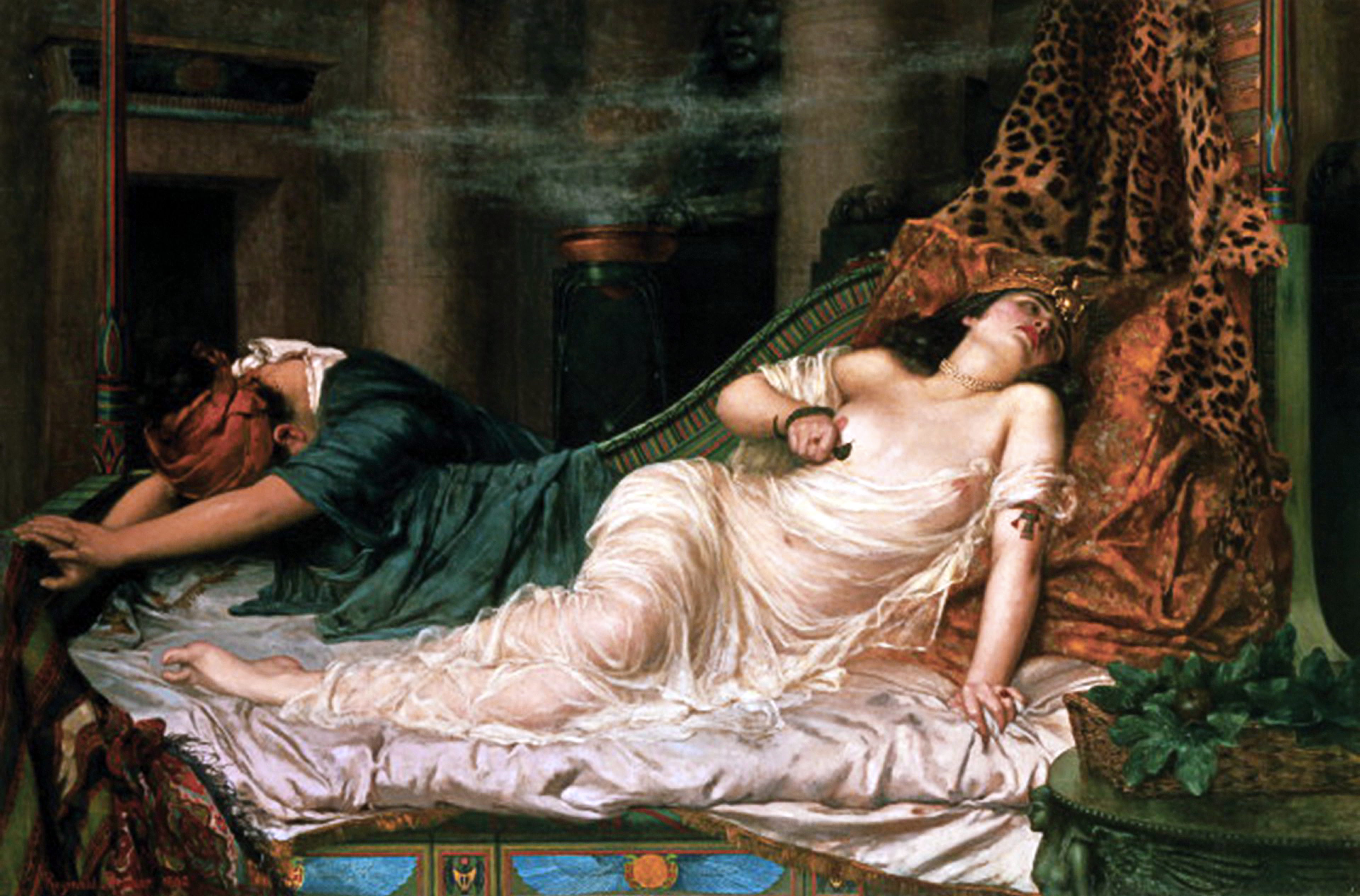
Death of Cleopatra by Reginald Arthur
Octavius is not surprised to see that Cleopatra is dead. He has known that she would rather die than being humiliated in public. But perhaps Octavius didn't guess that the queen would find means through the poison of an asp. He then gives her and Antony the last gift he can give: proper burial.

“She shall be buried by her Antony:
No grave upon the earth shall clip in it
A pair so famous. High events as these
Strike those that make them; and their story is
No less in pity than his glory which
Brought them to be lamented. Our army shall
In solemn show attend this funeral;”

Tuesday, 27 November 2012

Let's Read Play: Play List


I forgot to make a master post for all my participation in Let's Read Play Event held by Fanda. As you know, I haven't decided what play I am going to read for each month, so I will just leave them blank. They will be filled when I finish the play and the review as well. So, here we go.

Nov '12 Shakespeare's Tragedy

Dec '12 Shakespeare's Comedy

Jan '13. Freebie

Feb '13 Shakespeare's History

Mar '13 Greek

Apr '13 Shakespeare's Comedy

May '13 Shakespeare's Tragedy

Jun '13 Oscar Wilde

Jul '13 Other Author
(to be decided later)

Aug '13 Shakespeare's Comedy

Sep '13 Freebie
(to be decided later)

Oct '13 Shakespeare's Tragedy
(to be decided later)


Monday, 26 November 2012

Antony and Cleopatra, Act IV: Betrayed and Dead


The fourth act of Antony and Cleopatra is again set in field of war. Not really my kind of play. Yet there are things I want to pay attention to.

Firstly, the sign. Remember the soothsayer that told Antony not to fight Caesar? Well, “divine signs” have been a feature in old classics that must not be taken slightly. Just as Julius, Antony doesn't listen to the soothsayer (or has forgotten his warning) and wages war against Caesar. But then there is another sign coming among his men.

“Tis the god Hercules, whom Antony loved,
Now leaves him.”

To have such a sign like that means things won't work well with Antony. But it has nothing to do with us. We know that he is going to die anyway.

Second, Enobarbus' betrayal and Antony's reaction to it.

“Mark Antony
Who’s gone this morning?
Soldier
Who!
One ever near thee: call for Enobarbus,
He shall not hear thee; or from Caesar’s camp
Say ‘I am none of thine.’”

This betrayal must be a painful blow for Antony, since he counts Enobarbus as one of his closest friends. But Enobarbus doesn't hold the same high principles that Antony has in him. Antony at last feels the pain that Julius once experienced – being betrayed.

But he doesn't lose his temper. Instead he sends all Enobarbus' treasures back to him and even add more to it. Not just that, he even says that it is him that has changed Enobarbus for worse.

“Go, Eros, send his treasure after; do it;
Detain no jot, I charge thee: write to him —
I will subscribe — gentle adieus and greetings;
Say that I wish he never find more cause
To change a master. O, my fortunes have
Corrupted honest men! Dispatch. — Enobarbus!”

Now let's move to Octavius' camp. Octavius accepts Antony's ex-friends with hospitality, but pays not much trust to them. Talking about battle strategy, this is his plan:

“Go charge Agrippa
Plant those that have revolted in the van,
That Antony may seem to spend his fury
Upon himself.”

So it's not good at all for those who deserted Antony in his hour of need, eh? It's just natural for Caesar not to trust traitors. Who knows that nest time it is him they would betray when his luck runs short? 

Enobarbus now starts to understand that it was a bad decision to leave Antony, and he feels guilty about it. His feeling of guilt and shame becomes even more immense when he finds out that Antony has given him back his riches, despite his treason. The traitor then kills himself just like Judas.

I don't understand Cleopatra. Putting Antony to the test, she asks her servant to tell Antony that she is dead. Antony, then, kills himself. What kind of drama is this? But the noble Antony never forgets the important things. He tells Cleopatra to seek peace with Octavius, and to get back her honour and safety. Then as befits a king, he says goodbye, telling Cleopatra not to grieve upon his death, because he dies honourably.

Pompeo Batoni's painting depicting Antony's death
“The miserable change now at my end
Lament nor sorrow at; but please your thoughts
In feeding them with those my former fortunes
Wherein I lived, the greatest prince o’ the world,
The noblest; and do now not basely die,
Not cowardly put off my helmet to
My countryman — a Roman by a Roman
Valiantly vanquish’d. Now my spirit is going;
I can no more.”

The story is nearing its end. What will happen between Octavius and Cleopatra then? 

Sunday, 25 November 2012

Antony and Cleopatra, Act III: Love is Indeed Blind


If he were Caesar, and Caesar Antony, we would be compelled to rewrite every article of history since the death of Julius Caesar.

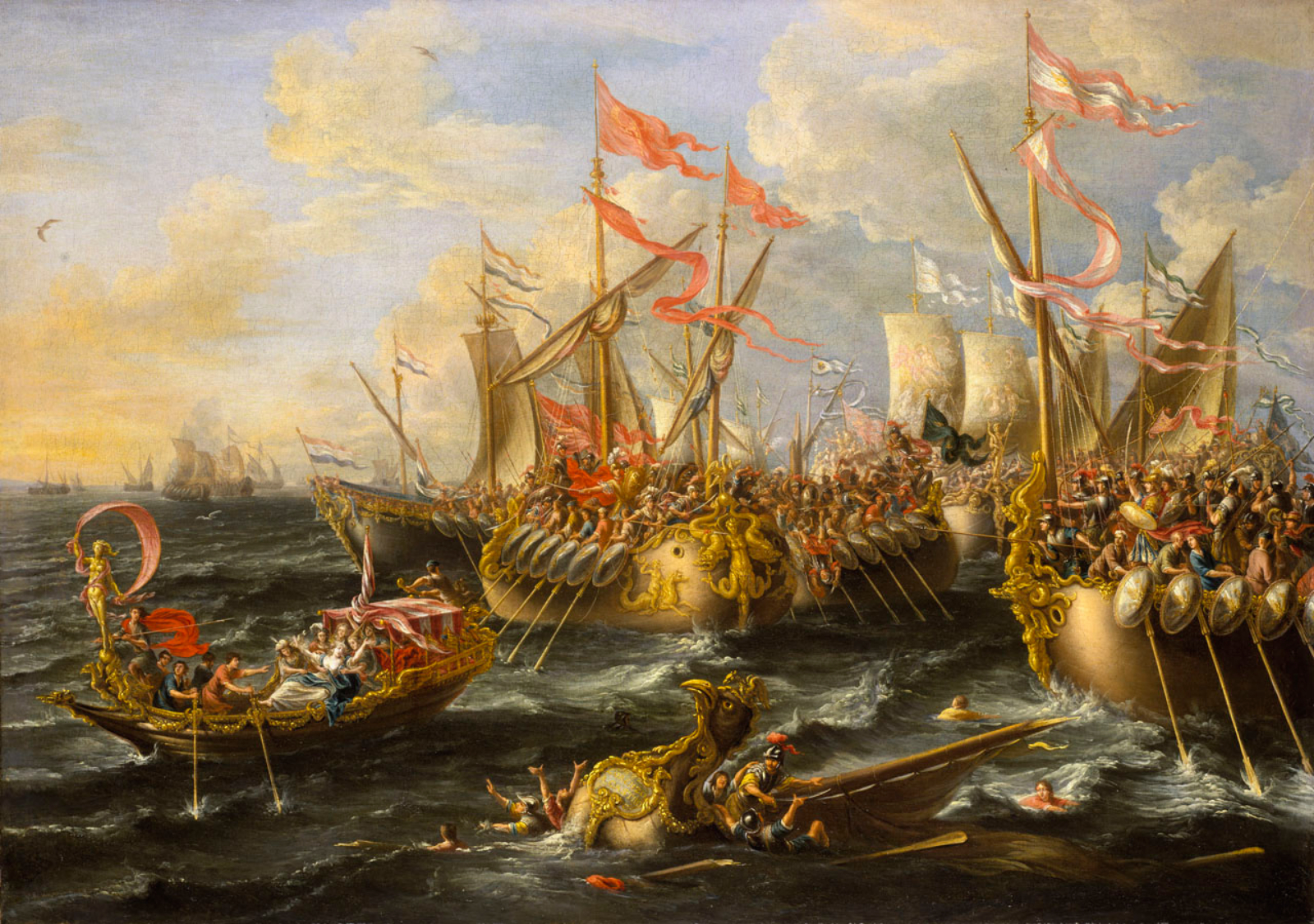
The Battle of Actium by Lorenzo A. Castro
Just a thought. The third act of Antony and Cleopatra has been emotional for me. It might be my bias for Antony, but I do admire some of his grand qualities. I have written about one of it in the review of the first act. Now let me continue to the second.

When he hears that Octavius wages war against Pompey, Antony becomes furious. Firstly, he starts to feel than Octavius doesn't count him as Roman co-ruler in the triumvirate. Secondly, he doesn't think that the war against Pompey is fair.

“Nay, nay, Octavia, not only that—
That were excusable, that and thousands more
Of semblable import—but he hath waged
New wars ’gainst Pompey; made his will, and read it
To public ear;
Spoke scantly of me; when perforce he could not
But pay me terms of honor, cold and sickly
He vented them, most narrow measure lent me.
When the best hint was given him, he not took ’t,
Or did it from his teeth.”

Given the fact that Pompey helped Antony in the past, thus making a link between the two, the murder of Pompey is utterly unacceptable from Antony's point of view. It enrages him to know that one of his subordinates killed Pompey.

“He’s walking in the garden — thus; and spurns
The rush that lies before him; cries, ‘Fool Lepidus!’
And threats the throat of that his officer
That murder’d Pompey.”

Another thing that I still like of him is kindness towards those who fight with him. Knowing that there is no longer hope to win, he offers his ship and the treasures in it to his soldiers, and also advices them to move to Octavius' side.

“Friends, come hither:
I am so lated in the world, that I
Have lost my way for ever: I have a ship
Laden with gold; take that, divide it; fly,
And make your peace with Caesar.”

The more I know Antony, the more I like him. And yet to me he is the same and both different man from what he is in Julius Caesar. His love to Cleopatra is almost mounting up to madness. He cannot think clearly, and also refuses to listen to Enobarbus' sound advice, that is to fight Octavius on land.

All these things cannot be good. I'd happily finish the play soon and make an elaborate review about it.

PS: The analysis done in this article is based solely on Shakespeare's work, regardless of its historical accuracy.